Address
304 North Cardinal St.
Dorchester Center, MA 02124
Work Hours
Monday to Friday: 7AM - 7PM
Weekend: 10AM - 5PM

Address
304 North Cardinal St.
Dorchester Center, MA 02124
Work Hours
Monday to Friday: 7AM - 7PM
Weekend: 10AM - 5PM

PACKING YOUR SUCCESS
PACKING YOUR SUCCESS
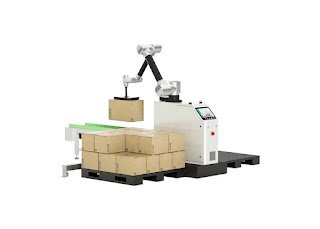
If you have ever walked
through a modern warehouse, you have likely seen them: robotic arms
swiftly and precisely stacking boxes onto pallets, layer after layer,
without pause. These machines are palletizing robots, and they have
quietly become one of the most valuable pieces of automation on the
production line.
At RAYNOR Packaging,
based in Kunshan, China, we manufacture palletizing robots alongside
our shrink wrap and cellophane packaging machines. In this guide, we
will explain what a palletizing robot is, how it works, why businesses
are adopting them, and where the technology stands today.

A
palletizing robot is an automated machine that stacks products—boxes,
bags, bottles, or other packaged goods—onto a pallet for storage or
shipment.
Using a robotic arm equipped with a gripper or suction device, it picks
items from a conveyor belt and places them onto a pallet in a
programmed pattern.
Palletizing robots are a key part of end-of-line automation. They operate at the very end of a production line, handling the final step before products leave the facility.
While
manual palletizing is still common, robotic palletizing is faster, more
consistent, and safer. It eliminates the physical strain of repetitive
heavy lifting and reduces the risk of errors that can lead to damaged
goods or unstable pallet loads.
Palletizing robots operate through a coordinated sequence of steps. Here is how the process typically works:
Step 1: Product Infeed
Products—whether boxes, bags, bottles, or other containers—arrive at the robotic cell via conveyor belt or other feeding system.
Step 2: Sensing and Perception
Sensors
and cameras on the robot detect the size, shape, and orientation of
each product. This information allows the robot to adjust its approach
for different item types.
Step 3: Robotic Arm Movement
A programmable logic controller (PLC) or computer system directs the robot arm to pick up the product. The arm uses an end-of-arm tool (EOAT) —such as a vacuum gripper, mechanical clamp, or magnetic pickup—to securely grasp each item.
Step 4: Placement and Stacking
The
robot places the product onto the pallet according to a predefined
stacking pattern. These patterns can be customized based on product
type, pallet size, and shipping requirements. The robot can adjust its
movements for different configurations, including interlocking layers
for stability.
Step 5: Pallet Handling and Repeat
Once
a pallet is fully stacked, the robot may signal for a new empty pallet.
The cycle repeats continuously until the production run is complete.
All
movements are guided by advanced software that calculates the optimal
stacking pattern to maximize space utilization and load stability.
Not all palletizing robots are the same. There are three primary types, each suited to different applications.
Articulated Arm Robots
use a jointed arm with multiple axes of movement. They are highly
flexible, can handle mixed products, and are easy to reprogram for
different layouts. They are ideal for facilities that run multiple
product lines or frequently change pallet patterns. However, they
require safety guarding around the work area.
Gantry (Cartesian) Robots
move on rails in straight lines—left/right, forward/back, up/down. They
are extremely precise, can handle very heavy loads, and work best in
high-volume applications where the palletizing layout remains
consistent. The trade-off is that they require more floor space and are
harder to reconfigure.
Collaborative Palletizers (Cobots)
are designed to work safely alongside human workers without fencing or
guarding. They are easier to install and program, making them accessible
to smaller operations. However, they operate at slower speeds and have
lower payload capacities. Cobots are ideal for low-speed lines, small
factories, or tasks where humans still need to intervene occasionally.
Why are companies investing in palletizing robots? The benefits are substantial and well-documented.
Speed and Throughput.
Robots work continuously without breaks, shifts, or fatigue. A single
robotic palletizer can often replace multiple manual workers while
running 24 hours a day. In one documented case, a palletizing system
reduced cycle time from 825 seconds to 770 seconds per pallet,
increasing annual output by over 2,700 pallets.
Consistency and Quality.
Robots stack according to programmed patterns every single time,
eliminating the errors that can occur with manual stacking. This means
more stable pallet loads, fewer damaged products, and less rework.
Safety.
Palletizing involves repetitive heavy lifting, which is a leading cause
of workplace injuries. Automating this task removes workers from
ergonomic risk and reduces injury-related downtime.
Labor Savings.
Labor shortages are a growing challenge in manufacturing and logistics
worldwide. A palletizing robot can automate a role that is increasingly
difficult to staff. One coffee company reported that two cobot
palletizers replaced eight workers per day, while boosting productivity
by 15%.
Return on Investment.
While robotic palletizing requires a higher upfront investment than
manual methods, the ROI is often achieved within 12 to 30 months. In
many cases, payback occurs in less than a year.
Flexibility.
Modern palletizing robots can handle multiple product types and pallet
patterns without hardware changeovers. They can be reprogrammed quickly,
adapting to new SKUs or customer requirements.
Palletizing robots are used in a remarkably wide range of industries.
Food and Beverage
is the largest application segment. From beverage cases to frozen food
boxes to bagged coffee, palletizing robots handle a vast array of
product types at high speeds.
Pharmaceutical and Chemical
facilities use palletizing robots to handle sensitive products with
precision and cleanliness, while also meeting strict regulatory
requirements for traceability.
Consumer Goods
manufacturers—from electronics to personal care products to household
goods—rely on palletizing robots to manage high SKU counts and seasonal
demand fluctuations.
Logistics and Distribution Centers
use palletizing robots to handle incoming and outgoing goods, improving
throughput and reducing the physical demands on warehouse staff.
Building Materials and Agriculture round out the major application areas, with palletizers handling heavy bags, sacks, and irregularly shaped items.
A well-implemented robotic palletizing system delivers three things:
Stable, secure pallet loads that can withstand shipping and storage without collapsing or shifting.
Consistent layer patterns that maximize pallet space and minimize wasted volume.
Integration with upstream and downstream equipment—conveyors, stretch wrappers, labeling systems, and warehouse management software—for seamless material flow.
Good
palletizing systems also include safety features such as emergency
stops, light curtains, and sensors that detect human presence, ensuring a
safe working environment.
The
palletizing robot market is growing rapidly. According to industry
research, the global palletizing robot market was valued at
approximately
3.37billionin2025andisprojectedtoreach∗∗
6.56 billion by 2030**, growing at a compound annual growth rate (CAGR) of 14.7%.
Key drivers of this growth include:
The continued expansion of e-commerce and distribution centers, which demand higher throughput and faster order fulfillment.
Increasing investment in smart factories and Industry 4.0 initiatives.
Rising
demand for collaborative robots (cobots) in palletizing applications,
which make automation accessible to smaller companies.
Labor shortages and the need to reduce operational costs through automation.
The Asia-Pacific region is the largest market for palletizing machinery, accounting for approximately 40% of global market share, followed by Europe and North America.
Leading
global manufacturers include Fujiyusoki, FANUC, ABB, KUKA, and YASKAWA,
with the top five companies holding more than 35% of the global market.
Traditional
palletizing relies on manual labor or basic mechanical equipment. While
it has a lower upfront cost, it comes with significant long-term
expenses: ongoing labor costs, injury risk, inconsistent throughput, and
high employee turnover.
Robotic
palletizing requires a higher initial investment but offers predictable
operating costs, higher accuracy, 24/7 operation, and improved worker
safety. For most businesses, the ROI justifies the upfront expense,
especially as labor markets continue to tighten.
Historically,
the palletizing robot market was dominated by Japan, Germany, and the
United States—home to brands like FANUC, YASKAWA, KUKA, and ABB. But the
manufacturing landscape has shifted.
China is now the world‘s largest exporter of industrial automation equipment, including palletizing robots.
Key provinces such as Jiangsu, Shandong, Henan, and Shanghai host dense
clusters of manufacturers specializing in packaging automation and
material handling machinery.
Several factors have driven China’s emergence:
Integrated supply chains – Access to local component suppliers reduces production lead times and lowers costs.
Skilled engineering talent – Proximity to technical universities and R&D centers has fostered rapid innovation in robotics and control systems.
Port access – Coastal cities enable efficient international shipping to North America, Europe, Southeast Asia, and the Middle East.
Economies of scale – Large production facilities allow mass manufacturing without sacrificing customization capabilities.
As
a result, Chinese-built palletizing robots now offer a compelling value
proposition: advanced technology at significantly more competitive
price points than equivalent European or Japanese models, without
compromising quality.
Kunshan,
located in Jiangsu Province, is one of China’s most advanced
manufacturing hubs for packaging machinery and industrial automation.
The city is part of the Yangtze River Delta manufacturing belt, which
provides access to a mature ecosystem of precision machining, control
systems, and materials fabrication.
What makes Kunshan particularly attractive for palletizing robot manufacturing?
Advanced R&D capabilities – Jiangsu Province is known for smart manufacturing initiatives and cutting-edge robotic solutions.
Complete supply chain – All components—servo motors, gearboxes, grippers, PLC controllers—are available locally, reducing lead times.
Skilled workforce – The region has a high density of mechanical and electrical engineers with years of experience in automation.
Export-ready infrastructure – Kunshan’s proximity to Shanghai‘s ports and airports makes international shipping fast and cost-effective.
Quality certifications – Many Kunshan-built machines carry CE, UL, or ISO 9001 certifications, meeting international safety and quality standards.
At RAYNOR Packaging,
we are proud to be part of Kunshan’s growing packaging automation
ecosystem. Our facilities produce palletizing robots alongside shrink
wrap machines and cellophane overwrappers, all built to international
standards. We combine local manufacturing expertise with a global
customer focus, delivering reliable automation solutions at competitive
prices.
Consider these questions:
Do you currently have workers manually stacking pallets at the end of your production line?
Are you experiencing labor shortages or high turnover in your warehouse or packaging department?
Do your pallet loads sometimes arrive damaged due to inconsistent stacking?
Are you looking to increase throughput without adding headcount?
If the answer to any of these is “yes”, a palletizing robot could deliver immediate benefits:
Reduce manual palletizing labor by up to 70–90%.
Increase pallet consistency and reduce product damage.
Improve workplace safety by eliminating ergonomic hazards.
The
palletizing robot has transformed end-of-line operations across
industries. What was once a manual, repetitive, and injury-prone task is
now handled by precise, tireless, and increasingly affordable machines.
With the global market projected to reach $6.56 billion by 2030, and
adoption accelerating across food, beverage, pharmaceutical, and
logistics sectors, there has never been a better time to evaluate
automation for your palletizing needs.
Whether
you run a small production line or a large distribution center, there
is a palletizing solution that fits your operation—from compact
collaborative robots to high-speed articulated arms.
Ready to see how a RAYNOR palletizing robot can improve your end-of-line operations? We build reliable, high-performance palletizing robots right here in Kunshan, China, and export to customers worldwide.
📞 Contact us at raynorpack.com for a quote or technical discussion.
📍 RAYNOR Packaging — Engineered in Kunshan, China, Delivered Worldwide.
